
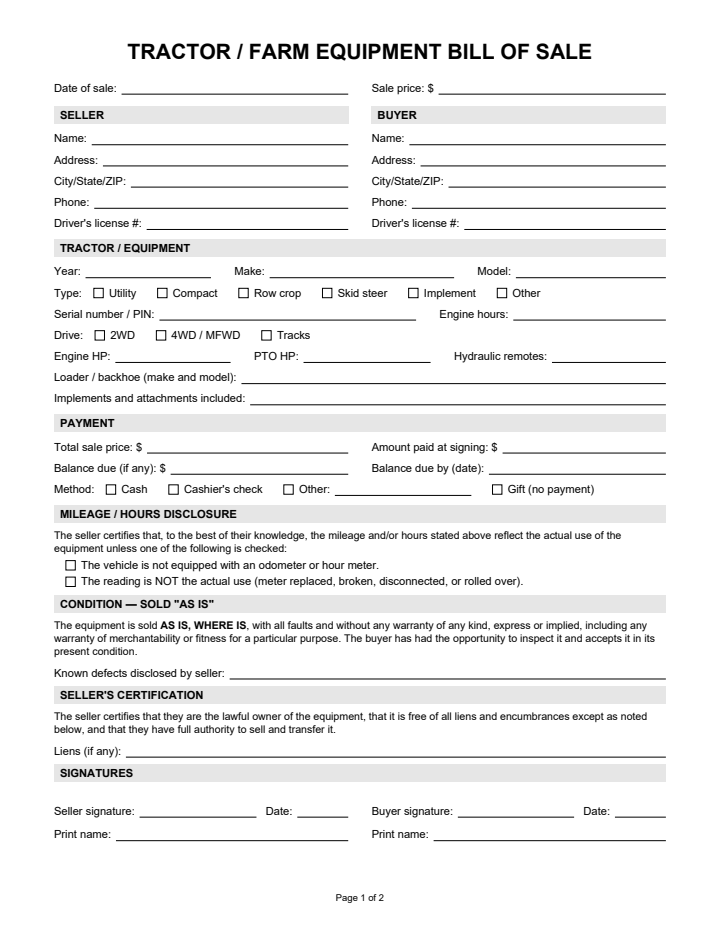
This template records the machine, its hours, the attachments that come with it and the seller's statement that it's owned free of liens. It suits tractors, skid steers, combines, balers, mowers and implements.
It's a fillable PDF: type into it in Acrobat, Preview or your browser and save the finished copy, or print it blank and fill it in by hand.
What's on the form
- Seller and buyer details
- Year, make and model
- Type: utility, compact, row crop, skid steer, implement or other
- Serial number or PIN, and engine hours
- Drive: 2WD, 4WD/MFWD or tracks
- Engine and PTO horsepower, and the number of hydraulic remotes
- Loader or backhoe make and model, and any implements included
- Price, a mileage and hours disclosure, an as-is clause and a lien certification
How to fill it out
-
Copy the serial number or PIN from the machine
It's on a stamped plate, usually on the frame rail below the cab, on the transmission housing or inside a side panel. Photograph it. On equipment this is the only identifier there is, and it's what a lien search runs against.
-
Search for liens before you pay
Financed equipment carries a UCC filing with the seller's Secretary of State, and those filings are public and searchable online. A lender with a filing can repossess the machine from a buyer who paid in good faith. This is the single most important check in a private equipment sale.
-
Record the hours and say if the meter has been replaced
Hours are the mileage of farm equipment. If the tachometer or hour meter has been swapped or has stopped, tick the disclosure box rather than writing a number you can't stand behind.
-
List every attachment by name
Loader, bucket, forks, box blade, rotary cutter, quick-attach plate, spare wheel weights, a second set of tires. Attachments are worth thousands and are the most common thing to go missing between the handshake and the pickup.
-
Write down the faults you know
Leaking hydraulics, a weeping rear main seal, a clutch on its way out, cracked tires, a bad PTO bearing. As-is covers what a buyer could find by inspecting; it doesn't cover a concealed problem.
Before you hand it over
- Farm equipment usually has no title. The bill of sale plus the serial number is the ownership record, so keep it as long as you own the machine.
- UCC liens follow the equipment, not the seller. Search the Secretary of State database in the seller's state before money changes hands.
- Agricultural sales tax exemptions vary. Some states exempt farm equipment bought for agricultural use, usually with an exemption certificate.
- Arrange transport before you buy. A tractor that runs isn't necessarily road legal, and hauling a 10,000 lb machine needs the right trailer and rating.
Questions
Do tractors have titles?
In most states, no. Tractors and implements are typically sold on a bill of sale alone, which is why the serial number and a signed record matter so much.
How do I check a tractor for a lien?
Search the UCC filings on the Secretary of State website for the state where the seller lives or farms, using their name and the equipment serial number. The search is usually free.
What are engine hours and what's high?
The hour meter counts running time, the equipment equivalent of mileage. What counts as high depends entirely on the class of machine and how it was maintained, so weigh hours against service records rather than on their own.
Does this work for implements without an engine?
Yes. Tick the implement type box, fill in the serial number and leave the hours and horsepower lines as N/A.