
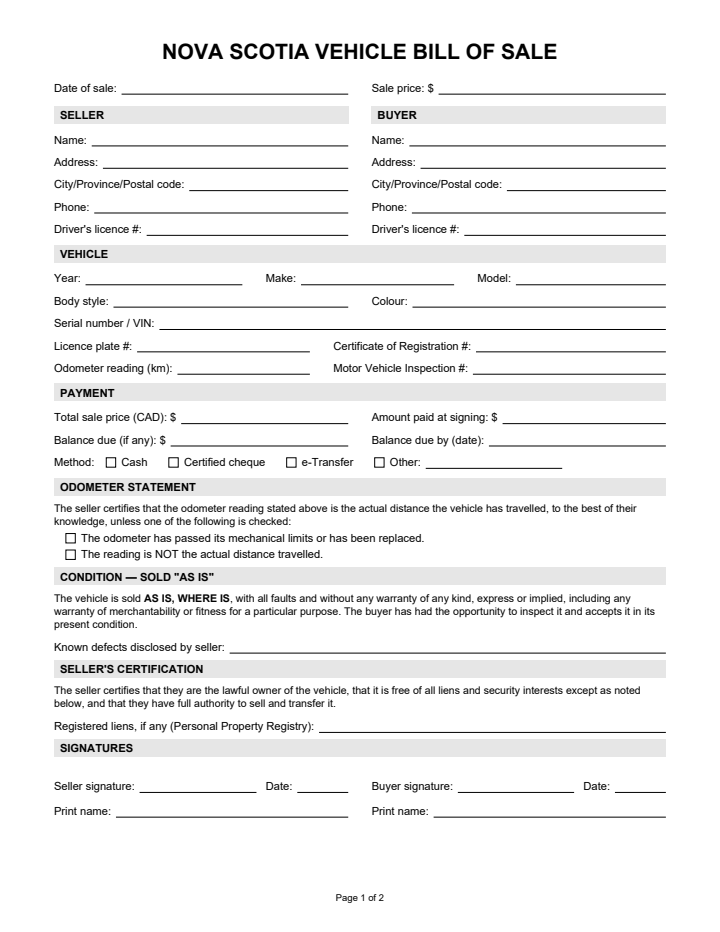
The bill of sale sits alongside that as the record of the price, the condition and what was agreed. The Registry also calculates tax from the price, so it needs to be right.
What Nova Scotia requires
-
Seller: sign the registration and file the notice of sale
Sign the back of the Certificate of Registration, complete the Transfer of Title Certificate of Sale (Part 1) for the buyer, then sign the notice of sale naming the buyer and return it to the Registry of Motor Vehicles right away.
-
Seller: take your plates
Plates stay with you. Move them to another vehicle, or hand them back for a refund on the unused portion.
-
Buyer: 30 days to transfer
Complete the Application for Certificate of Registration (Part 4) within 30 days of the purchase. The vehicle counts as registered to you for up to 30 days if valid plates assigned to you are on it; after that it is expired until you re-register.
-
What to bring to the Registry
Parts 1 and 4 completed, Part 3 as well if the plates belong to someone other than the buyer, identification, a Statement of Insurance, a valid Motor Vehicle Inspection number and the transfer fee, plus tax and registration fees.
-
Tax: 14% on the greater of price or book value
Nova Scotia Sales Tax is payable at transfer on the greater of the purchase price or the Canadian Red Book value. If the vehicle is genuinely worth less, you can have it appraised before the transfer and the tax is based on the greater of the appraisal or the price. Some family gifts are exempt with acceptable proof.
Worth knowing
- No plates on the day? A temporary permit is available from any Registry office, valid for 30 days.
- A Motor Vehicle Inspection number is part of the transfer, so check the inspection status before you agree a price.
- Writing a low price does not reduce the tax, because the Registry uses the Red Book value when it is higher.
- File the notice of sale promptly. It is the seller's protection once the vehicle is gone.
Questions
Do you need a bill of sale in Nova Scotia?
The transfer itself runs on the Certificate of Registration, but a bill of sale is what records the price, date, condition and parties — and the price is what the tax is calculated from.
How long do I have to register a vehicle I bought in Nova Scotia?
30 days from the purchase date. Until then the vehicle counts as registered to you only if it carries valid plates assigned to you.
How much tax do I pay on a private vehicle sale?
14% Nova Scotia Sales Tax, calculated on the greater of what you paid or the Canadian Red Book value, with an appraisal route available if the vehicle is worth less.
Do licence plates transfer with the car?
No. The seller keeps the plates and can move them to another vehicle or return them for a partial refund.
Checked against Nova Scotia’s own motor vehicle agency in November 2026. Rules change — confirm on the official pages listed before you rely on this, and treat it as general information rather than legal advice.