
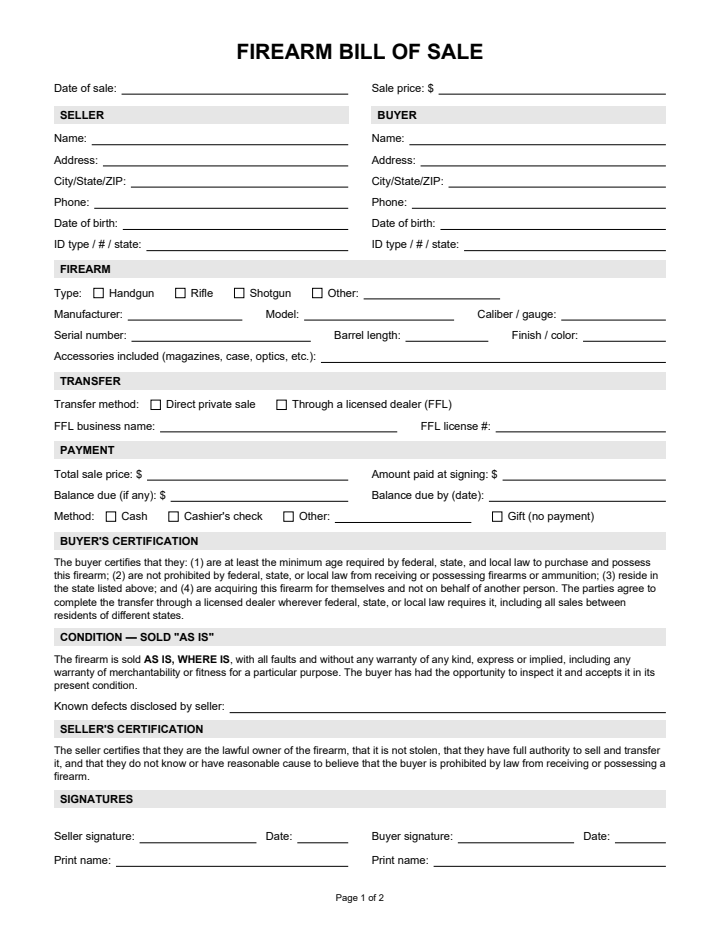
It is a record, not a permission slip. It does not replace a background check, a dealer transfer or any permit your state requires.
It's a fillable PDF: type into it in Acrobat, Preview or your browser and save the finished copy, or print it blank and fill it in by hand.
What's on the form
- Seller and buyer details, including date of birth and ID type, number and issuing state
- Type checkboxes: handgun, rifle, shotgun or other
- Manufacturer, model and caliber or gauge
- Serial number, barrel length and finish
- Accessories included, such as magazines, case or optics
- Transfer method: direct private sale or through a licensed dealer, with space for the FFL's name and license number
- A buyer's certification covering age, eligibility, residency and buying for themselves
- A seller's certification that the gun isn't stolen and that they have no reason to believe the buyer is prohibited
How to fill it out
-
Check your state's law first
This is the step that matters most. Some states require every private sale to go through a licensed dealer or include a background check. Others require a permit, a waiting period or a state form. The rules differ enormously between states and sometimes between cities.
-
Confirm you're both residents of the same state
Federal law generally requires a transfer between residents of different states to go through a licensed dealer in the buyer's state. Interstate private sales are where otherwise careful people break federal law.
-
Copy the serial number exactly
It's stamped on the frame or receiver. Check it character by character, including letters that look like digits. This is the only field that identifies the specific gun.
-
Read the buyer's certification together
It covers age, legal eligibility, residency and buying for themselves rather than for someone else. Buying on behalf of another person is a straw purchase and a federal crime.
-
Don't sell if anything feels wrong
A seller may not transfer a firearm to someone they know or have reasonable cause to believe is prohibited. If the buyer is evasive, seems impaired, or says anything that worries you, stop. Signed paperwork is not a defense.
Before you hand it over
- A bill of sale is not a background check. It records a transfer; it doesn't make an unlawful one lawful.
- Going through a licensed dealer is the safest route, and in several states it's required. The dealer runs the check and keeps the record. There's usually a modest fee.
- Keep your copy indefinitely. Unlike a car, there's no registration to update, so your copy is the only proof of when the gun left your possession.
- Some states require reporting private transfers. Check before assuming a handshake deal is complete.
Questions
Is a bill of sale required for a private gun sale?
Federal law doesn't require one for a private sale, and some states do require paperwork or a dealer transfer. Even where nothing is required, a signed record protects the seller.
Does this replace a background check?
No. Where a background check is required — by your state, or federally for a dealer transfer — it still has to happen. This form only records the sale.
Can I sell a gun to someone in another state?
Not directly as a private sale. Federal law generally requires the transfer to go through a licensed dealer in the buyer's state.
Should I photocopy the buyer's ID?
The form has space for the ID type, number and state, which is the usual practice. Keeping a copy of the ID itself is a personal choice, and some sellers do. Store it securely if you do.