
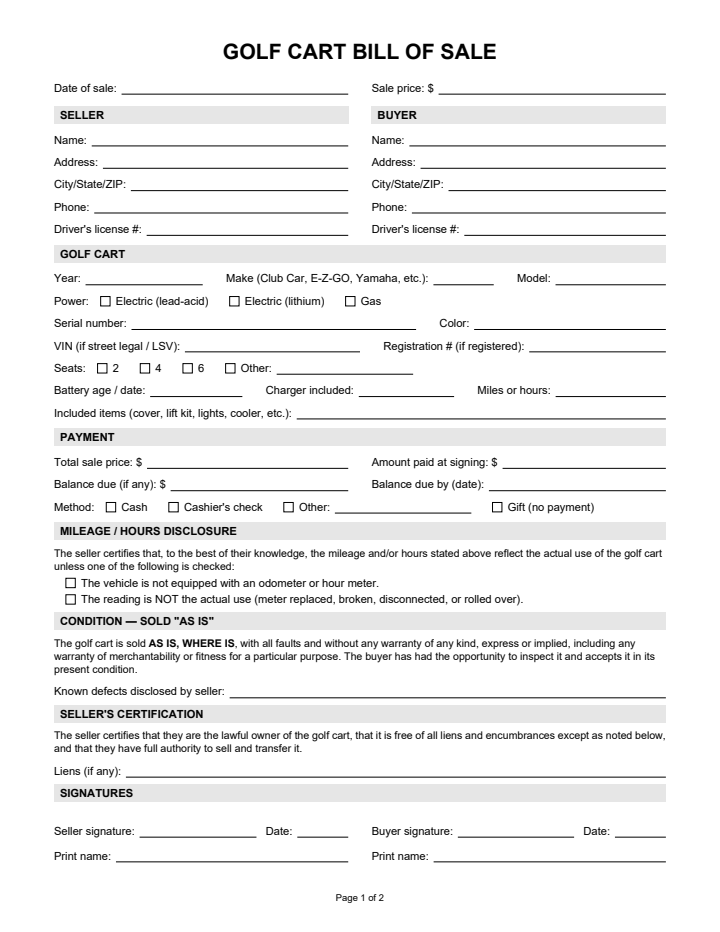
That makes the bill of sale the ownership document. This template records the serial number, the battery situation and whether the cart is street legal, which is what disputes tend to turn on.
It's a fillable PDF: type into it in Acrobat, Preview or your browser and save the finished copy, or print it blank and fill it in by hand.
What's on the form
- Seller and buyer details
- Year, make (Club Car, E-Z-GO, Yamaha and so on), model and color
- Serial number, and a VIN line for street-legal carts
- Power type: lead-acid electric, lithium electric or gas
- Registration number where the cart is registered as a low-speed vehicle
- Seat count, battery age, whether the charger is included, and miles or hours
- Included extras such as a lift kit, lights, cover or cooler
- Price, a mileage and hours disclosure, an as-is clause and signature lines
How to fill it out
-
Find the serial number
Usually under the seat, on the frame rail, inside the glove box or on the dash. Club Car, E-Z-GO and Yamaha all put it in different places, and the serial is what identifies the cart and its build year.
-
Write down the battery age
On an electric cart this is the single biggest number in the deal. A full set of lead-acid batteries costs a significant fraction of what a used cart is worth, and they last roughly four to six years. Lithium packs cost more up front and last longer.
-
Say whether the charger is included
A cart without its matching charger is a problem, and replacements aren't cheap. Tick the line either way so nobody assumes.
-
Be clear about street legality
A standard golf cart and a low-speed vehicle are different things legally. An LSV goes faster, has a VIN, and in most states needs registration, insurance and equipment like mirrors, lights, seat belts and a windshield. If the cart is just a cart, don't imply otherwise.
-
List the extras and the faults
Lift kit, upgraded wheels, light bar, rear seat, cooler. Then the honest part: weak batteries, a dead cell, a slipping belt, a broken charger. Writing them down is what makes the as-is clause stick.
Before you hand it over
- Most golf carts have no title. The bill of sale plus the serial number is the ownership record, so both sides should keep a signed copy.
- Street-legal carts are a different category. LSVs have a VIN and usually need registration and insurance, so check your state's rules before driving one on a public road.
- Test the batteries before buying. A cart that runs fine around the block can fade badly on a hill once the pack is worn.
- Communities have their own rules. Some neighbourhoods and courses require registration, decals or insurance for carts used on their paths.
Questions
Do I need a title to sell a golf cart?
Usually not. Standard golf carts aren't titled in most states. Street-legal low-speed vehicles often are, and those also carry a VIN.
What's the difference between a golf cart and an LSV?
Speed and equipment. A low-speed vehicle is built to go faster than a golf cart and must have safety equipment, a VIN, and in most states registration and insurance to use public roads.
How much are the batteries worth?
Enough to change the price of the deal. A replacement lead-acid set is a major expense and packs typically last four to six years, so the battery date on the form matters as much as the cart's year.
Does a golf cart bill of sale need to be notarized?
Almost never, but page 2 is a notary acknowledgment if a buyer, community or insurer wants one.