
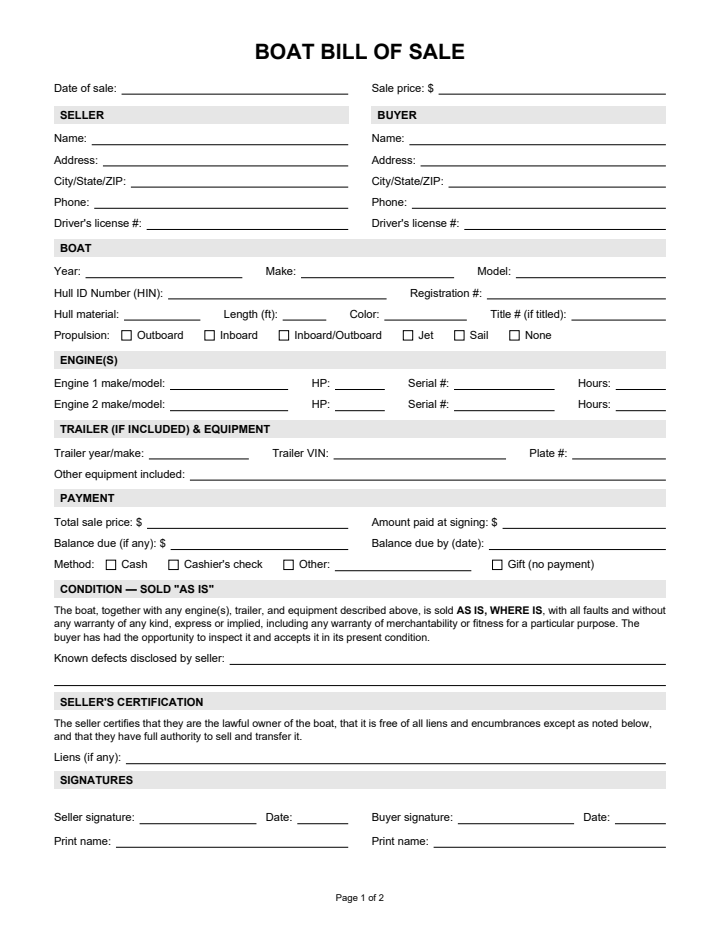
This template records all three on one page, with a notary acknowledgment on page 2 for states that require one.
It's a fillable PDF: type into it in Acrobat, Preview or your browser and save the finished copy, or print it blank and fill it in by hand.
What's on the form
- Seller and buyer details
- Year, make, model, hull material, length and color
- Hull Identification Number (HIN) and registration number
- Title number, where the state titles boats
- Propulsion checkboxes: outboard, inboard, inboard/outboard, jet, sail or none
- Make, model, horsepower, serial number and hours for up to two engines
- Trailer year, make, VIN and plate, plus a line for other equipment included
- Price, as-is clause covering the boat, engines and trailer, and signature lines
How to fill it out
-
Copy the HIN from the transom
The Hull Identification Number is a 12-character code moulded or plated into the upper starboard corner of the transom. It's the boat's VIN. Check it matches the registration and title.
-
Record each engine separately
Engine serial numbers are on a plate on the block or the transom bracket. On a twin-engine boat, write both — they're often sold, stolen and insured separately from the hull.
-
Decide about the trailer in writing
A trailer is usually a separately titled vehicle. If it's part of the deal, fill in its VIN and plate; if it isn't, write N/A so there's no argument at the ramp.
-
List the gear that's staying
Electronics, safety equipment, covers, spare props, anchors. Anything not written down tends to disappear between the handshake and the handover.
-
Note engine hours and known faults
Hours are the boating equivalent of mileage. Soft transom, weeping lower unit, tired impeller — write the faults you know about on the defects line.
Before you hand it over
- Boat rules differ from car rules. Some states title boats, others only register them, and larger vessels may be documented with the U.S. Coast Guard instead.
- Check for liens before paying. Boat loans are common and don't always show on a registration card.
- The trailer transfers separately. If it's titled, its title needs signing over too.
- Sales tax is usually due where the boat is registered, not where it was bought.
Questions
Where is the hull ID number on a boat?
Upper starboard corner of the transom, at the back right of the boat as you look at it from behind. It's a 12-character code, and there's often a duplicate hidden elsewhere on the hull.
Do I need a title to sell a boat?
It depends on your state and the boat's size. Where boats are titled, the signed title transfers ownership and the bill of sale records the deal. Where they aren't, the bill of sale plus the registration is the paper trail.
Does this form cover the outboard motor?
Yes. There's space for two engines with serial numbers and hours, and the as-is clause names the engines and the trailer alongside the hull.
Do I need a notary for a boat sale?
Some states require notarization for boat transfers, more often than for cars. Page 2 is there for that, and it asks for the HIN rather than a VIN.